


What Defines a B2B Brand Positioning Strategy?
A B2B brand positioning strategy is a plan that shapes how customers see a company compared to its competitors. Its main goals are to set the brand apart, show its unique value, and become the top choice in the market. This helps a business get an edge over competitors, attract the right customers, and build its loyalty. The process involves analyzing customers, company strengths, and the competition. Based on that analysis, a company must define its brand, find its unique value, and create a clear story and promise that connect with its audience. This strategy then guides all marketing and sales messages.
What is its unique value proposition (UVP)?
Unique Value Proposition (UVP) is a short, clear statement that explains the main benefit a business offers its customers. It is also known as a Unique Selling Proposition (USP) and acts as a clear promise to your customers.
What a UVP Does
- Shows your benefits: It clearly states the special value a customer gets.
- Explains why you’re different: It shows why your product is better than the competition.
- Solves a problem: It explains how you fix a specific problem for your customer.
The Three Parts of a UVP
A good UVP focuses on three things:
- Your Strengths: What your company does well.
- Customer Needs: How you meet what your customers need.
- Your Edge: How you are better than your competitors.
How does a positioning statement guide it?
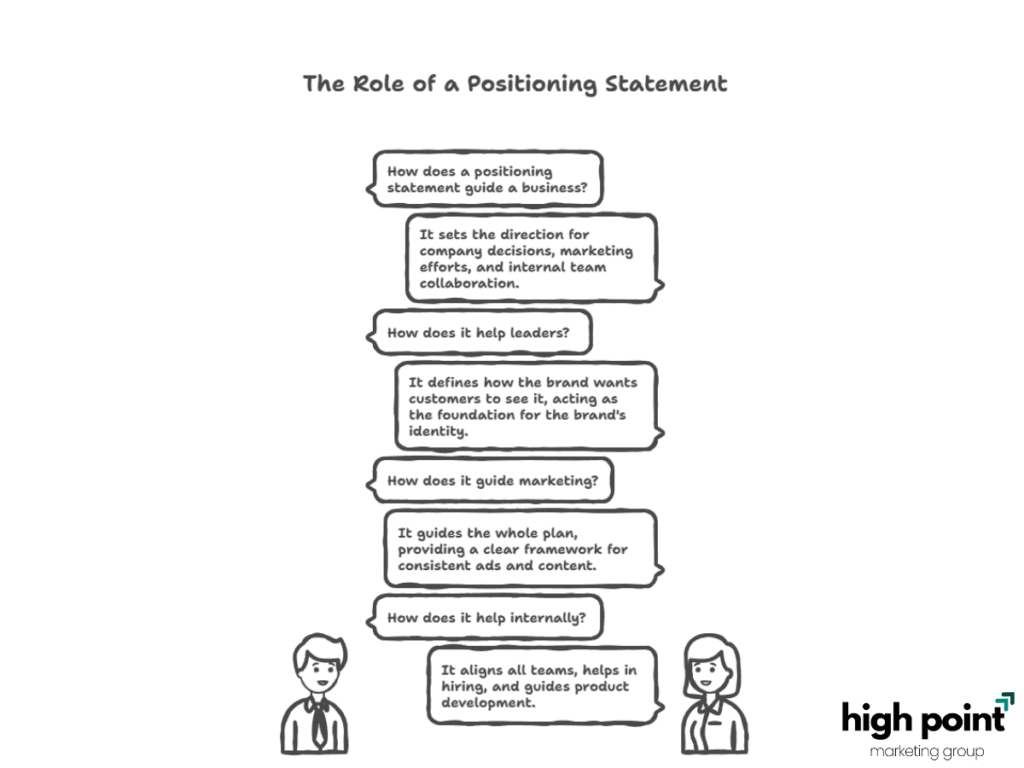
A positioning statement is a guide for a business that sets the direction for company decisions, marketing efforts, and how internal teams work together. It acts as the foundation for the brand’s identity and helps leaders make key decisions by defining how the brand wants customers to see it. For marketing, the statement guides the whole plan, providing a clear framework for creating consistent ads and content that connect with the right customers. Internally, it aligns all teams, helps in hiring the right people, and guides the development of new products and services.
Why are target audience insights foundational?
Understanding your target audience is the essential first step for any successful business because it forms the foundation for all strategic planning and actions. These insights guide a company’s long-term goals and overall business strategy by showing what customers truly care about. This then directs daily work by helping to focus marketing efforts, write better messages, and create products that solve real customer problems. Ultimately, it allows a business to make important choices based on facts instead of guesses, because it provides a clear understanding of who customers are and why they make their decisions.
How Does a B2B Brand Positioning Strategy Differentiate a Brand?
B2B brand positioning strategy differentiates a brand by intentionally shaping how customers see it compared to competitors, to hold a unique place in their minds. The process involves finding gaps in the market where the brand can succeed and creating a clear plan to communicate its unique value. This differentiation is achieved by highlighting specific strengths that customers care about, such as special product features, superior customer service, a unique brand personality, or specialization in a niche industry.
What role does competitive analysis play?
Competitive analysis is a plan to study your competitors to learn their strategies, strengths, and weaknesses. Its main role is to give you the information needed to make smart business decisions, shape your strategy, and get an edge in the market.
Learning About Competitors
- It is the process of finding your competitors and studying their plans, marketing, and sales methods.
- It gives you key information about the strengths and weaknesses of other companies compared to your own.
- It helps you understand market trends and what customers like.
Guiding Plans and Decisions
- It is a key part of making and changing a company’s overall plan.
- The information helps you make choices about new products, pricing, and marketing.
- It helps you base decisions on facts, not guesses, and lets you compare your performance to others.
Getting an Edge Over Competitors
- It helps your business find and gain an advantage over others.
- It lets you find and use gaps in the market that others have missed.
- It helps you find ways to make your products different.
- It helps create tools and plans so your sales team can win more.
What are examples of effective brand positioning?
Good brand positioning helps a brand stand out by creating a special image for customers. Well-known examples include Apple (innovation), Nike (empowerment), and Tesla (sustainability).
Brand Positioning Examples
- Apple: Focuses on innovation and high-quality design.
- Tesla: Is known for sustainability and performance.
- Nike: Uses a message of empowerment (“Just Do It”).
- Coca-Cola: Positions itself around happiness and togetherness.
- Avis: Used to be number two as a strength with “We try harder.”
- Dollar Shave Club: Focuses on being low-cost and convenient.
- Louis Vuitton: Is positioned as a top luxury brand with high prices.
- TOMS: Stands out by giving back to the community.
Types of Positioning
- Positioning by customer service
- Positioning by convenience
- Positioning by price
- Positioning by quality
- Positioning by benefit
- Positioning by competitor
How Do You Execute a B2B Brand Positioning Strategy?
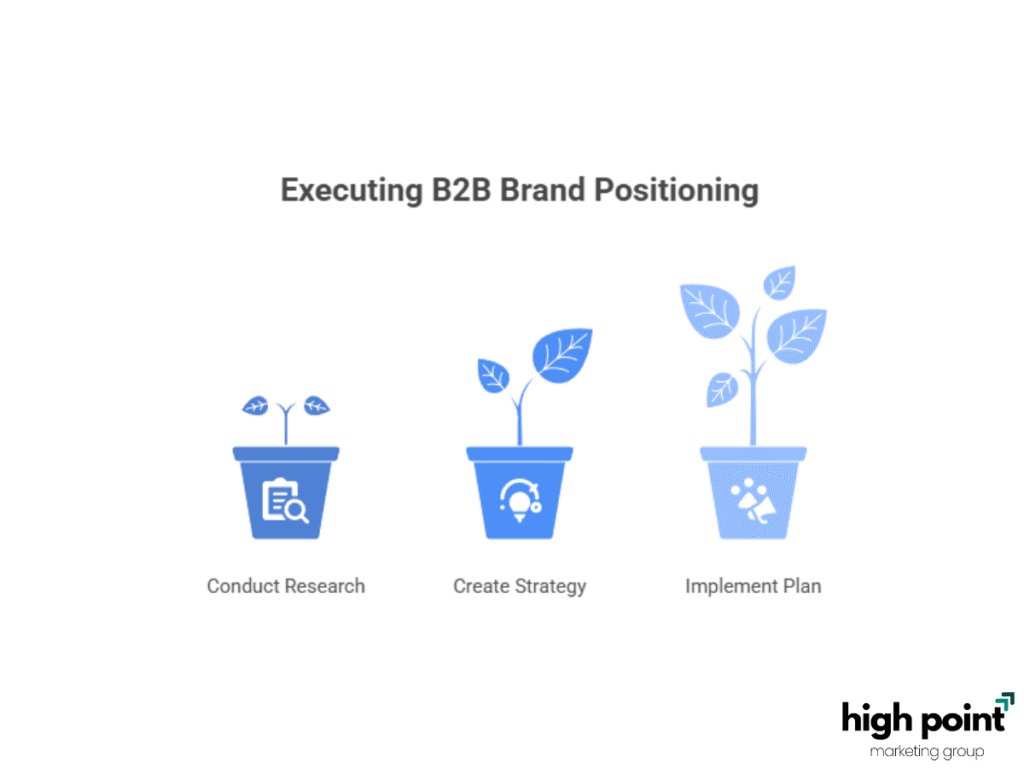
Executing a B2B brand positioning strategy is a three-part process. First, you conduct research by looking at your own company’s values, studying your customers’ needs, and analyzing your competitors’ strengths. Based on that research, you then create your core strategy by defining your unique value, deciding how your brand will be different, and writing a clear positioning statement. Finally, you put the plan into action by updating all marketing materials like your website, running campaigns with stories and case studies, and ensuring everyone in the company tells the same consistent story about the brand.
What frameworks can you use to build it?
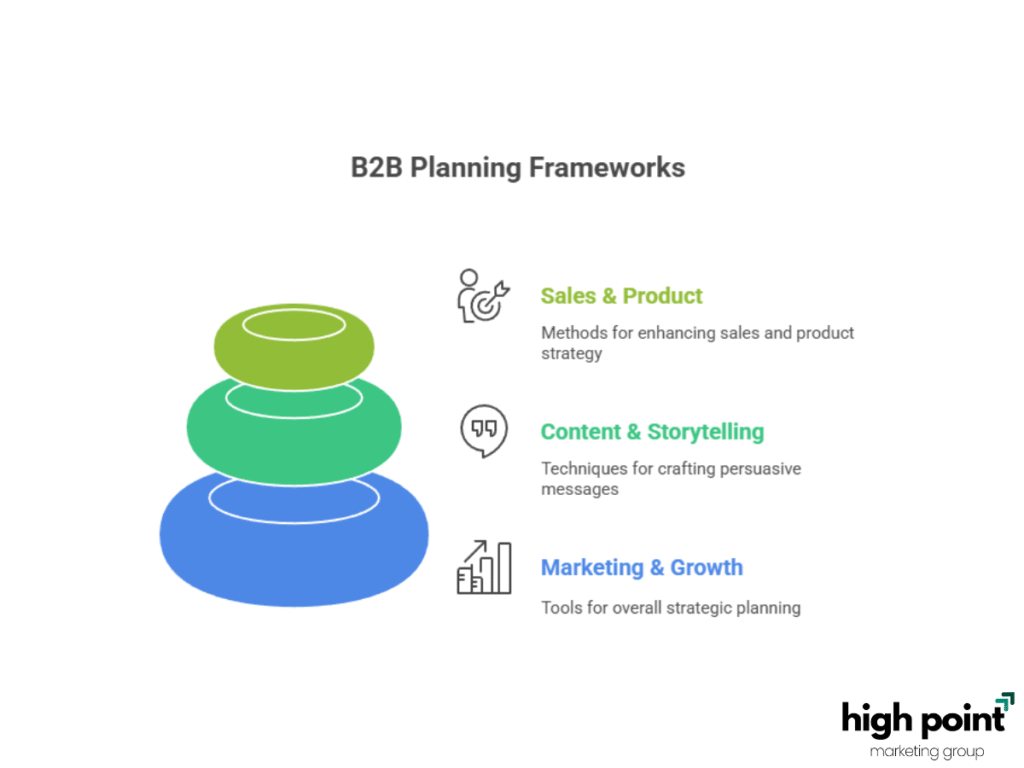
To build a B2B plan, you can use different types of frameworks. They usually fall into three groups: Marketing and Growth for overall planning, Content and Storytelling for writing good messages, and Sales and Product for helping with sales and products.
Marketing and Growth Frameworks
- SMART Framework: Helps you set clear goals.
- Racecar Framework: Sorts your growth tasks into different types.
- Anthony Pierri’s Framework: Helps connect your plan to your website and messages.
- Buyer Persona Frameworks: Organize your research about your customers.
Content and Storytelling Frameworks
- AIDA: A model to guide a customer to make a purchase.
- PAS: A simple formula for writing messages that persuade.
- The Hero’s Journey: A popular structure for telling brand stories.
- CAR Framework: A way to structure success stories.
Sales and Product Frameworks
- Sales Funnel: A map of a customer’s journey to buying something.
- Lead Qualification: A method to check if a potential customer is a good fit.
- Sales Enablement Framework: A plan to give your sales team the tools they need to succeed.
- Product Strategy Framework: Helps a company reach its product and financial goals.
What Types of Positioning Affect a B2B Brand Positioning Strategy?
B2B brand’s strategy is affected by several types of positioning that help it find its spot in the market. This includes broad concepts like Brand Positioning, the overall plan for the company, versus Product Positioning, a smaller plan for a single item. It also includes Market Positioning, which sets a brand’s level, like basic or luxury. Specific strategies that companies use include Value-based (focusing on unique value), Quality-based (emphasizing high quality), Price-based (using price to be different), Comparative (comparing directly to competitors), and Niche Market (targeting a small, specific group).
How does consumer positioning compare?
Consumer positioning is how a customer sees a brand compared to its competitors, based on factors like price, quality, or personal taste. This comparison can be vertical (based on measurable things like price) or horizontal (based on personal preference). Businesses analyze this by using tools like perceptual maps and head-to-head comparisons to see where they stand. They then use this information in strategic plans, such as Comparative Positioning, to directly compare their product against another and influence how customers perceive them. Consumer positioning and brand positioning strategy
What positioning variables should you consider?
To create a strong positioning plan, you should consider variables from three main areas. First, understand your customers by knowing who they are, what problems you solve for them, and what they value. Next, analyze your competition to see who they are, how you are different, and what market you are in. Finally, look at your own company by defining your unique value, brand identity, and price, and ensure the plan matches your overall business goals. Key variables in brand positioning examples
What is an example of over-positioning a brand?
An example of over-positioning is a luxury car brand marketing itself only as “the car for CEOs.” This is a marketing error where a brand is defined too narrowly, causing it to miss out on or alienate other potential customers, such as other wealthy professionals who are not CEOs.
Examples of Over-Positioning a Brand
How a brand positioning strategy can lead to over-positioning. Over-positioning happens when a brand’s focus becomes so specific that it limits its market reach, or when its claims are not seen as credible. Here are a few clear examples:
- A luxury car brand positioned only as “the car for CEOs,” which ignores other affluent buyers.
- A line of electronics made specifically for “extreme weather golfers,” creating an excessively small target market.
- A high-end restaurant that focuses only on a very niche gourmet market, neglecting customers who want a more casual (but still high-quality) experience.
- An energy drink makes exaggerated claims of “instant and miraculous results,” which can cause consumers to doubt its credibility.