


What Is a Diversification Strategy?
Diversification strategy means a company adds new products, moves into new markets, or does both at once to grow. Selling the first new product to the first new customer defines the move called diversification.
The Ansoff Matrix places this move in the highest-risk corner because two unknowns stack on the same launch. Most companies pick diversification only after testing cheaper paths such as market penetration or product development. Two practical checks guide the decision: first, does the core product have at least 12 more months of growth available? Second, does the company have unused skills or staff the new line could absorb?
A diversification strategy runs at any business size, from a single coffee shop adding pastries to a Fortune 500 brand acquiring a new industry. The mechanics stay the same; only the scale of the spend changes. [site: Bain & Company 2026 portfolio review]
Key Objectives
Three goals drive a diversification decision:
- Grow profit: New revenue streams raise the total top line each quarter.
- Lower risk: One slow product no longer breaks the business.
- Reach new buyers: New segments, regions, or industries open without rebuilding the product.
Implementation Methods
Three paths take diversification from idea to launch. The right one depends on your budget, timeline, and risk comfort.
| Method | What happens | Cost | Speed | Best for |
|---|---|---|---|---|
| Build new products. | The internal team designs and ships the new offering | Medium spend | Slow (6–18 months) | Companies with R&D teams who want full control |
| Acquire | Buy another business that already sells the new product. | Highest spend | Fast (3–6 months) | Companies that need fast entry to a new market |
| License or partner | Sign a deal to sell someone else’s product. | Lowest spend | Fast (1–3 months) | Companies that want market exposure without the product cost |
What Are the 4 Types of Diversification Strategy?
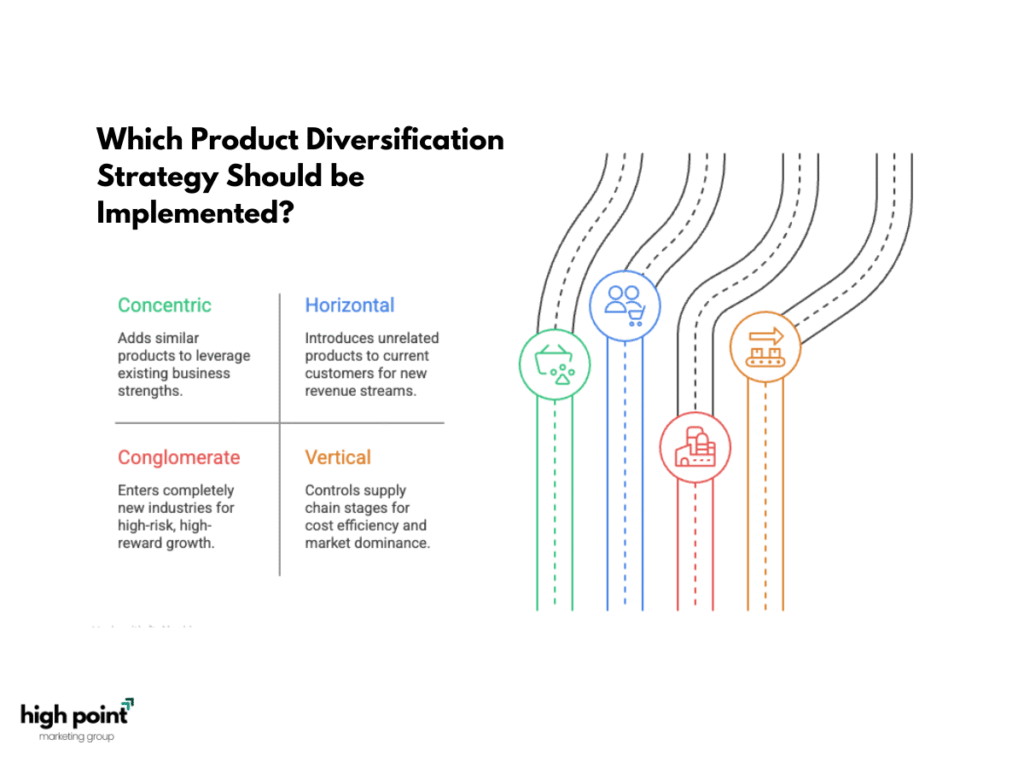
The four types come from the Ansoff Matrix. Each one carries a different mix of new product and new market. Pick one based on how close the new line sits to what you already sell.
- Concentric: New products that share technology, customers, or sales channel with the existing range. Lowest execution risk. Example: a pizza shop adds garlic knots to its menu.
- Horizontal: New products that target your current customers but solve a different problem. Example: a phone maker sells headphones and chargers.
- Conglomerate: New products in an unrelated industry, bought or built. Highest cash risk, lowest customer overlap. Example: a car maker buys a pizza chain.
- Vertical: Owns a new step in the supply chain, the path that moves raw materials to finished goods and delivers them to buyers. Example: a pizza shop buys the tomato farm upstream or opens its own delivery downstream.
The four types of diversification strategy sit on the same 2×2 grid as the Ansoff Matrix. The new-product axis runs vertical (No, Yes). The new-market axis runs horizontal (No, Yes). Diversification lives at the Yes-Yes intersection.
| New-product → / New-market ↓ | Existing product | New product |
|---|---|---|
| Existing market | Market penetration | Product development |
| New market | Market development | Diversification |
What is concentric diversification?
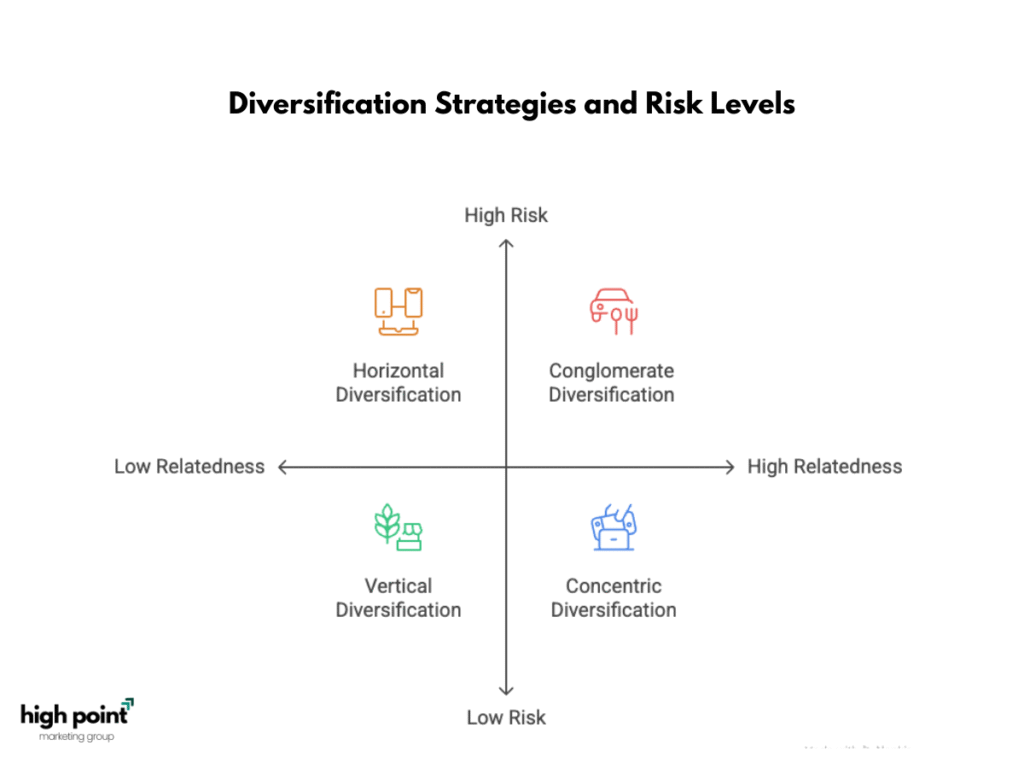
Concentric diversification is the lowest-risk diversification move. A company adds new products or services that stay close to its existing business through shared tech, brand, or customer base. Concentric cuts launch risk because the new line rides on existing capability.
- What it is: New but related or complementary products join the existing line.
- How it works: The company uses its existing technology, resources, and core skills.
- Main goal: Grow revenue while keeping financial risk low.
- Example: A computer maker starts producing laptops. A pizza shop adds garlic knots. Both use skills they already have.
What is horizontal diversification?
Horizontal diversification sits in the middle of the risk range. A company sells new and unrelated products to its existing customer base. Horizontal bets the existing relationship rather than the existing product.
- What it is: New items that solve a different problem for the same buyer.
- Who it targets: Current, repeat customers.
- Why it works: Trust and reach already exist, so launch costs stay low.
- Example: A phone maker sells headphones and chargers; Apple launched AirPods and Apple Watch to existing iPhone owners.
What is conglomerate diversification?
Conglomerate diversification carries the highest execution risk. A company expands into a business that shares no customer, no product, and no channel with its current operations. Conglomerate spreads risk across unrelated revenue sources rather than depending on a single industry.
- What it is: Owning businesses with no shared buyer, product, or supply chain.
- Why companies pick it: One business can perform poorly while another performs well, smoothing overall returns.
- How it usually grows: Through acquisition of companies in different industries.
- Example: Virgin Group spans airlines, mobile, fitness, and space tourism; Berkshire Hathaway owns insurance, railroads, and energy in unrelated industries.
What is vertical diversification?
Vertical diversification owns a new step in the chain that gets a product from raw materials to a finished buyer. Vertical aims to control cost, quality, or speed, not to reach new buyers.
The move runs in two directions:
- Backward (upstream): Buy the suppliers who feed your inputs. Example: a pizza shop buys the tomato farm.
- Forward (downstream): Buy the distributors or retailers who deliver your product. Example: a pizza shop opens its own delivery service.
- Frontier example: Tesla’s gigafactories make the batteries its own cars need; this is forward vertical integration at scale.
Recommended Video: Search YouTube for “product diversification strategy examples” to watch a visual guide.
What Are the Advantages of a Diversification Strategy?
Diversification creates four wins when a company picks it for the right reason. The wins multiply when both a new product and a new market arrive at once.
- More profit paths: Two products beat one when revenue per product flattens out.
- Lower single-product risk: A failed launch in the new line does not threaten the core business.
- Wider customer reach: New products draw new buyer groups into the brand’s orbit.
- Better use of staff and tools: Existing staff, tools, and channels serve the new line from day one.
When Diversification Beats Other Ansoff Paths
Diversification wins when the main product has reached its natural ceiling. It loses when existing products still have growth room, because market penetration costs less and pays back faster. The decision rule is simple: pick diversification only after penetration, market development, and product development no longer carry the business forward.
What Are the Risks and Disadvantages of Diversification?
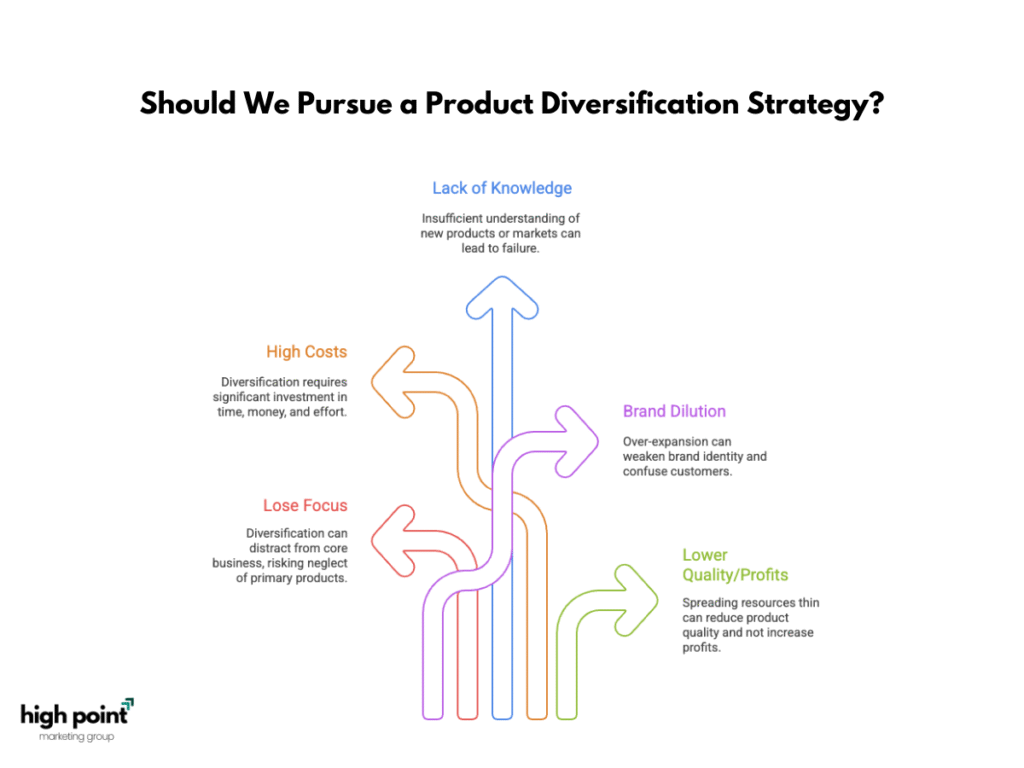
Diversification costs more than the other three Ansoff paths because two unknowns stack. Five failure modes show up most often.
- Lost focus on the core: Staff and cash drift to the new line. The main product slips.
- Higher spend and complexity: Two product lines mean two budgets, two teams, and two launch plans.
- Knowledge gaps: The team does not yet know the new market. Early bets miss.
- Brand confusion: Buyers stop associating the brand with one clear thing. Example: a toothpaste brand launching frozen pizza confuses buyers fast.
- Lower quality across both lines: Resources thin out. Quality drops on both ends.
When Diversification Is the Wrong Call
Pick market penetration or product development instead when the core product has more than 12 months of growth runway. Diversification costs cash up front and pays back slower; it only wins when no cheaper path can carry the company forward. [site: Bain & Company 2026 portfolio review]
5 Real Diversification Strategy Examples
These five companies show each Ansoff quadrant working in the real world. Each example ends with the marketing lesson behind the move.
| Company | Type | Marketing lesson |
|---|---|---|
| Coca-Cola → Dasani water | Concentric | Reuse the same trucks, same stores, same brand. Costs less than building a new route to market. |
| Apple → AirPods | Horizontal | Sell the second product next to the first. Existing demand makes the launch cheaper. |
| Berkshire Hathaway → GEICO + BNSF + Dairy Queen | Conglomerate | Hold unrelated businesses for cash flow, not customer overlap. |
| Tesla → battery gigafactories | Vertical forward | Own the bottleneck. Pricing power moves to your side of the table. |
| A regional SaaS firm → Canada and Mexico | Market diversification | Same product, new geography. Lowest-cost way to grow without R&D spend. |
Diversification in Marketing: 3 Mini-Examples
Marketing teams apply the same four types at a smaller scale. Each example costs less than the corporate version.
- Concentric in marketing: A SaaS firm adds an AI tier on top of its core product. Same buyer, same channel.
- Horizontal in marketing: A DTC brand opens a retail pop-up alongside its Shopify store. Same product, new sales channel.
- Market diversification in marketing: A US vendor translates the help center into Spanish and opens a Latin America pricing plan. Zero product change.
Diversification Strategy in Strategic Management
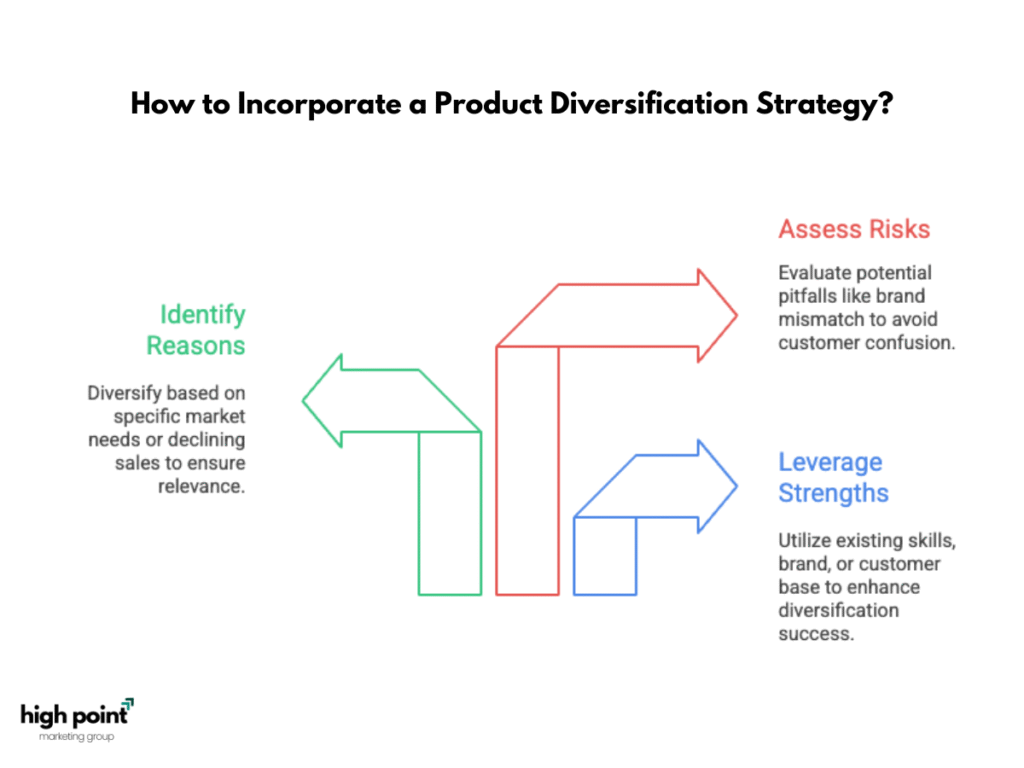
When company leaders decide to sell new types of products (diversify), they treat it as a major plan. Here’s how they think about it:
- They Use the Company’s Strengths: They start with what the company is already good at. This could be a special skill (like Honda’s great engines), a famous brand name (like Apple), or its loyal customers.
- They Have a Good Reason: They usually diversify for a specific reason, such as when sales of their main product are slowing down or because customers start wanting different things.
- They Check the Risks: Before starting, they think about what could go wrong. The biggest risk is creating a new product that doesn’t fit the brand’s image, which can confuse or upset customers (like a toothpaste company selling frozen dinners).
How Does Diversification Work in Marketing?
From a marketing point of view, product diversification is a plan to grow a business by selling new products, often to new customers.
Here’s how marketing sees it:
- The Main Goal: To increase sales and make more profit with new items.
- Who to Sell To: The strategy aims to reach new types of customers in different markets.
- How it Affects the Brand: It can make a brand look more innovative and able to meet more customer needs.
- Testing is Important: Marketers must test the new product to make sure people will want to buy it.
Note: This is different from “marketing channel diversification,” which means using more places (like social media, TV, and email) to advertise.
What is a marketing diversification strategy?
A “marketing diversification strategy” can mean two different things:
- Selling New Products (The Main Meaning): This is a plan for the whole company to grow by making new products and selling them in new markets. The main goals are to make more money and lower business risk.
- Using More Ad Channels (A Marketing Tactic): This is just for the marketing team. It means using many different ways to advertise (like Facebook, Google, and email) instead of relying on only one. This makes your marketing safer. Ansoff Matrix
Should You Consider Alternatives to a Product Diversification Strategy?
Yes, you should consider other options. Selling new products isn’t always the right move for every business.
Here’s a simple guide on when to choose:
Sell New Products (Diversify) if:
- Your main business is slowing down or has stopped growing.
- You want to make your business safer by not relying on just one thing.
Stick to Your Main Business (The Alternative) if:
- You can still grow by selling more of what you already make.
- You are not sure how to manage selling completely new things.
The main alternative to selling new products is to focus on what you already do best.
How Does Market Diversification Differ From Product Diversification?
Market diversification and product diversification are not the same thing. Product diversification adds a new product. Market diversification adds a new customer group or a new location. The two often happen together, but they solve different problems. Market Expansion for E-commerce and Retail
Here is a breakdown of how these strategies differ:
| Dimension of Difference | How the Strategies Vary |
| By Strategic Type | Strategies are classified into four main types: concentric (adding related products), horizontal (new products for current customers), vertical (controlling the supply chain), and conglomerate (entering a completely unrelated business). |
| By Relatedness | A key distinction is whether the new venture is related to the company’s current business (sharing technology, products, or markets) or unrelated (entering a new field). |
| By Strategic Focus | The focus can differ: Product Diversification adds new products/services, Market Diversification enters new industries or customer segments, and Geographical Diversification expands to new locations. |
| By Application Context | In business, diversification is a growth strategy using new products and markets. In financial investing, it is a risk management technique using different assets (like stocks and bonds) to reduce portfolio volatility. |
| Versus Expansion | Diversification differs from expansion. Diversification means branching into new and different areas, while expansion means scaling up and strengthening what a company already does. |
Frequently Asked Questions
Q: What is a diversification strategy?
A diversification strategy means a company grows by offering new products, entering new markets, or both at once. It sits in the highest-risk corner of the Ansoff Matrix guide. Companies use it to grow profit, reduce single-product risk, and reach new buyers without depending on one core offering. Most companies run a cheaper Ansoff path first. [site: Harvard Business Review 2026]
Q: What is diversification in marketing?
Diversification in marketing applies the same four Ansoff types to channels and audiences instead of products. A marketing team launches a new channel, a new segment, or a completely different audience. The four types stay the same — concentric, horizontal, conglomerate, and vertical — though the unit of risk drops to a quarter’s spend rather than a balance sheet.
Q: How is diversification different from market development?
Market development sells the existing product to a new customer segment, geography, or industry. Diversification adds a new product at the same time, so two unknowns stack. Market development costs less and pays back faster because the product is already proven. Most companies test market development first.
Q: What are the 4 types of diversification strategy?
The 4 types are concentric (related new product), horizontal (new product for current customers), conglomerate (unrelated business in any industry), and vertical (a new step in the supply chain). Concentric carries the lowest risk. Conglomerate carries the highest. Vertical sits in the middle on cost but controls supply lines.
Q: What is the Ansoff Matrix?
The Ansoff Matrix is a 2×2 grid that maps four growth paths: market penetration, market development, product development, and diversification. Diversification sits at the Yes-Yes intersection and ranks as the highest-risk path because two unknowns stack on the same launch.
Q: Is diversification a high-risk strategy?
Yes, relative to the other three Ansoff paths. Risk comes from two sources at once: new product fit with buyers and new market response to your offer. Core product sales often drop during the new line’s first year because staff and cash move to the launch.
Q: What is diversification with examples?
Five named diversification examples appear in this article: Coca-Cola launching Dasani water (concentric), Apple launching AirPods (horizontal), Virgin Group and Berkshire Hathaway (conglomerate), Tesla building its own battery supply (vertical forward), and a regional SaaS firm expanding into Canada and Mexico (market diversification).
Q: What does product diversification mean?
Product diversification means a company adds a new product to grow. The product can connect to what the company already sells, or it can be completely different. It always adds a new item to the lineup, not just a new customer group.